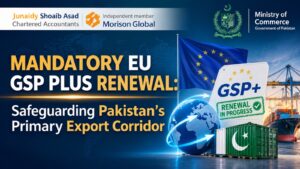
For Pakistan’s export-oriented manufacturing base, preferential European trade access has long served as a vital buffer against regional price competition. That advantage now faces a mandatory statutory test. German Ambassador Ina Lepel officially confirmed in Islamabad that Pakistan’s market access under the European Union Generalized Scheme of Preferences Plus (GSP Plus) is undergoing formal renewal ahead of the European Union’s revised trade framework launching in 2028. With bilateral trade with Germany stagnating at approximately 3.5 billion euros annually since 2017, the European Commission’s recent evaluation report establishes rigorous compliance benchmarks across international labor conventions, human rights treaties, environmental sustainability, and governance standards.
What this practically means for textile composite mills, leather garment manufacturers, and surgical export houses is that retaining the duty-free twelve to fourteen percent tariff advantage is existential. As European retail buyers face tightening corporate sustainability reporting mandates, failure to satisfy GSP Plus monitoring benchmarks would directly reintroduce standard tariffs, wiping out commercial margins against South Asian competitors. Corporate sustainability leads and factory management must immediately audit shop-floor compliance, supply chain traceability, and environmental reporting against the twenty-seven core international conventions.